
How to Wear Halo Extensions So the Wire Never Shows
Quick answer
To wear halo extensions so the wire never shows, size the wire so the band sits just above your ears, twist your crown hair into a bun, place the halo below it like a headband, lock it with the two clip-in wefts, then release the bun so a full layer of your own hair covers the wire.
Learning how to wear halo extensions is mostly about one thing: keeping a thin, clear wire out of sight. The hair itself is rarely the problem. When a halo gives itself away, it is almost always because the wire is the wrong size, it sits too high, or there is not enough natural hair layered over it. Fix those three and the halo becomes one of the fastest, most undetectable ways to add length and volume at home.
In this guide
- Why does a halo wire show?
- Is a halo right for your hair?
- Get the wire size right first
- How to wear halo extensions, step by step
- Where the wire peeks through, and how to fix it
- Styles that hide the wire (and ones that don't)
- Color and length: the other half of blending
- Care that keeps your halo blending
- Halo extension FAQs
Why does a halo wire show?

A halo is a single wide weft of hair attached to a loop of fine, clear wire. Instead of clipping into your hair, the wire rests around your head like a headband, and your own hair falls over it to hide the band. There is no glue, no bond, and no tension on your roots, which is why halos are so gentle. It is also why placement matters: the wire is only invisible when something covers it.
In practice, a visible wire comes down to a short list of causes:
- The loop is too big. A loose wire slides back and down, and the halo shifts every time you turn your head.
- The loop is too small. A tight wire pushes the halo up toward your crown, where your hair is thinnest and the band sits in the open.
- The top section is too thin. If you only leave a few strands over the wire, light passes straight through them.
- The style lifts your hair away. Slick-backs, tight high ponytails, and windy days all expose the band.
Every tip in this guide solves one of those four problems.
New to extensions?
Halos sit alongside clip-ins and ponytails in the temporary range, so you can add hair for a day and take it out at night with no salon visit.
Browse ready-to-wear hair extensions →Is a halo right for your hair?

Superior Hair's Classic Halo Weft Extensions work best when your natural hair is at least shoulder length. Shorter hair can't fall over the wire and blend into the weft. They suit thin to medium and medium-thick hair types.
If your hair is very fine through the crown, be honest with yourself. A halo needs a layer of your own hair on top to hide the band, so if that layer is sparse, a different option may serve you better. Our guide to the best extension methods for fine and thin hair walks through the alternatives, and for thinning right at the crown, human hair toppers add coverage exactly where a halo can't.
Here is how the halo compares with the other at-home options:
| Method | How it attaches | What can show | Best for |
|---|---|---|---|
| Classic halo | Clear wire band around the head, plus two small clip-in wefts | The wire, if the top section is thin or lifted | Fast everyday volume, hair at least shoulder length |
| Classic clip-ins | Several wefts clipped into horizontal sections | Clips or weft edges if placed too high | Maximum fullness and custom placement |
| Seamless clip-ins | Clip-in wefts with a flatter, thinner base | Very little, even in finer hair | Finer hair that wants clip-in flexibility |
Get the wire size right first
This is the step most people skip, and it decides everything else. Superior Hair halos come with a choice of six differently sized nylon wires, so you can match the band to your head rather than forcing your head to fit the band.
To find your size, hold the halo up and let it rest around your head where a headband would sit at the back, just above the tops of your ears. Then check three things:
- It stays put when you tilt your head forward. If it slides toward your neck, go a size smaller.
- It doesn't ride up. If the weft wants to climb toward your crown, the loop is too tight. Go a size larger.
- It feels like nothing. You should be able to forget it is there. Pressure behind the ears means it is too small.
Size it once with your hair dry and styled the way you usually wear it, since extra volume underneath changes how high the band sits.
How to wear halo extensions, step by step
With the wire sized, the actual application takes well under a minute once you have done it a few times. Each Classic Halo set includes one main 10-inch-wide halo piece and two 4-inch clip-in wefts. Those small wefts keep everything locked and hidden.
1. Detangle both heads of hair
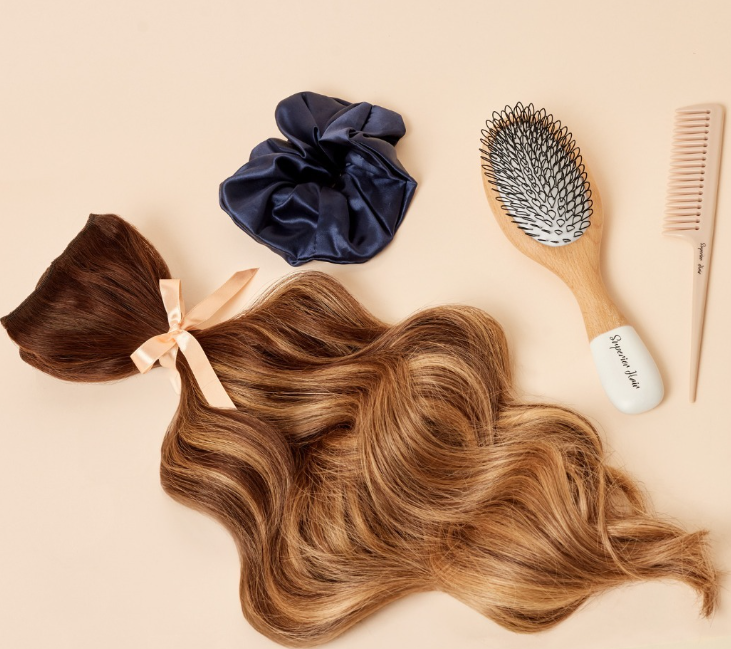
Brush your own hair and the halo so both are smooth and tangle-free. A wide-tooth comb, paddle brush, or a dedicated extension brush from our hair extension tools range works well. Knots at the weft line make blending harder later.
2. Section the crown into a bun
Take a generous section at your crown and twist it into a bun on top of your head. Leave a few pieces out at the front to frame your face. Be generous here. A thicker top section is the single best insurance against a visible wire.
3. Place the halo below the bun
Set the wire around your head along the part line just beneath the bun, so it sits like a headband. It should feel secure above your ears, with the weft lying flat against the back of your head.
4. Lock it with the clip-in wefts
Clip one 4-inch weft on each side, roughly two inches above your ears. Fasten the clip closest to your hairline first. This anchors the halo at the sides, adds fullness where a halo alone can look thin, and stops the band from shifting when you move.
5. Release, then blend
Let the bun down so your own hair falls over the wire. Brush gently from the mid-lengths down, working your natural hair into the extensions. Avoid brushing hard at the root, where you could snag the wire and pull it into view. Check the back in a hand mirror before you head out.
If you also own clip-ins and want to see how wefts are placed around the head, our clip-in placement map shows where the side wefts naturally sit.
Not sure of your shade?
A hidden wire only goes so far if the color is off. Send in a few photos and the team will help match your halo to your natural hair.
Get a free color matchWhere the wire peeks through, and how to fix it
Even with a well-sized wire, a few trouble spots come up often.
Above the ears
This is where the band is closest to the surface. If you tuck your hair behind your ears, the wire can glint through. Keep a little hair loose over the ears, or pull the side sections forward slightly so they drape over the band.
At the crown when you bend
Leaning forward lets the top layer fall away from the back of your head. A slightly thicker crown section, or a light tease at the root of that section, gives it enough body to stay over the wire when you move.
In wind or bright sunlight
Strong backlight can catch clear wire. A soft wave scatters light better than poker-straight hair, so the band disappears more easily.
Styles that hide the wire (and ones that don't)
Because Superior Hair halos are 100% Remy human hair with the cuticle aligned in one direction, you can curl, straighten, and style them with hot tools just like your own hair. Always apply a heat protectant first, and keep your tools at a moderate setting, around 350°F, to protect the hair over many wears.
Styles that work beautifully:
- Loose waves or curls, which blend the weft line and add movement over the wire
- A soft half-up style, taking the top section from above the band
- A low, loose braid that starts below the band
Styles to skip with a halo:
- High ponytails and top knots, which pull your hair up and off the band
- Tight slicked-back looks with nothing covering the crown
- Anything tucked tightly behind both ears
Color and length: the other half of blending
A perfectly hidden wire still gives you away if the halo is a different color or the length jumps suddenly. Two things help.
Match the color at the mid-lengths and ends. That is where the halo meets your own hair, so it matters far more than your root color. Halo sets include a tester piece (one of the 4-inch wefts sits on top of the box) so you can check the match against your hair in daylight before opening the rest of the package. The Classic Halo color guide shows every shade side by side. If your hair has natural dimension, a blended shade such as Chocolate Brown Balayage often disappears into it more easily than a single flat color.
Choose a sensible length. Classic halos come in two lengths: a 16-inch set at 140 grams (a 110-gram halo piece plus two 15-gram wefts) and a 20-inch set at 180 grams (a 140-gram halo piece plus two 20-gram wefts). The bigger the jump from your natural length, the harder the blend, so hair just past the shoulders usually looks most believable at 16 inches. Longer hair carries 20 inches easily, with extra density through the back.
Care that keeps your halo blending
A halo that tangles or dries out stops blending, no matter how well the wire is hidden. A few habits keep it looking like your own hair for longer:
- Wash it rarely. Every 10 to 15 wears is plenty. Over-washing strips the hair faster than wearing it does.
- Go sulfate-free and alcohol-free. Both dry out extension hair, which cannot draw natural oils from a scalp.
- Never brush it wet. Let it dry, then detangle from the ends up.
- Take it off before sleeping or swimming. Both cause tangling and can stretch or bend the wire out of shape.
- Leave it uncolored. Don't bleach, lighten, or dye your halo.
- Store it flat. Keep the halo in its box with the wire in a smooth loop so it doesn't kink.
Our full hair care guide covers washing, drying, and storing in more detail.
Ready for length and volume in under a minute?
Every Classic Halo is 100% Remy human hair, with six wire sizes and two clip-in wefts so it fits securely and stays hidden.
Shop Classic Halo Extensions →Halo extension FAQs
How do you wear halo extensions without the wire showing?
Size the wire so it rests just above your ears without sliding or riding up. Twist a generous crown section into a bun, set the halo below it like a headband, and secure it with the two clip-in wefts. Then release the bun so a thick layer of your own hair covers the band, and brush gently to blend.
How long does your hair need to be to wear a halo?
Superior Hair's Classic Halo extensions work best on natural hair that is at least shoulder length. Your own hair needs enough length to fall over the wire and blend into the weft. Shorter hair tends to leave a visible step between your ends and the extensions, so clip-ins are usually the better choice for shorter styles.
Can halo extensions work on thin hair?
Yes, halos suit thin to medium and medium-thick hair, and they put no tension on your roots. The key is leaving enough hair at the crown to cover the wire. If your hair is very sparse right at the crown, a topper or seamless clip-ins may give better coverage than a halo.
Can you sleep or swim in halo extensions?
No. Take your halo off before bed and before swimming. Sleeping in it causes tangling at the weft and can bend the wire, while pool and sea water dry out the hair. Halos are designed to go on in under a minute and come off just as fast, so daily removal is part of the routine.
Do halo extensions damage your natural hair?
A correctly sized halo does not damage your hair, because it rests on your head rather than gripping or bonding to it. The two small clip-in wefts hold lightly at the sides. To keep it that way, brush gently at the root, avoid a wire that is too tight, and remove the halo every night.