
Invisi Butterfly Weft Extensions: The Flattest Weft We Make
Quick answer
Invisi butterfly weft extensions are semi-permanent 100% Remy human hair wefts built on Superior Hair's thin Invisi base. A stylist attaches them with silicone-lined microbeads through pre-punched "butterfly holes," then flips the weft to hide the beads. No glue, sewing, or tape. Installs take about 15 minutes and need maintenance every 4 to 6 weeks.
Invisi butterfly weft extensions exist because of one complaint we kept hearing: wefts can feel like a ridge along the head, and fine hair shows every ridge. The original Butterfly Weft fixed most of that. The Invisi version goes a step further by swapping the base for the same ultra-thin material used in our Invisi Tape line, so the weft lies closer to the scalp than anything else we make. Here is how it works and who it suits.
In this guide
What are invisi butterfly weft extensions?

A weft is a long strip of hair joined along one edge. How that strip attaches to your own hair is what separates one weft method from another. Traditional wefts are sewn onto a braid or beaded row. Tape-ins are sandwiched with adhesive. A butterfly weft does neither.
Instead, the base has small holes punched along it in pairs, which is where the "butterfly" name comes from. Your stylist pulls a small section of your natural hair through a pair of holes, secures it with a silicone-lined microbead, and repeats across the row. Then the weft is flipped over so it hangs down and covers the beads. You may also hear the method called a butterfly hole weft or invisible silk hole weft.
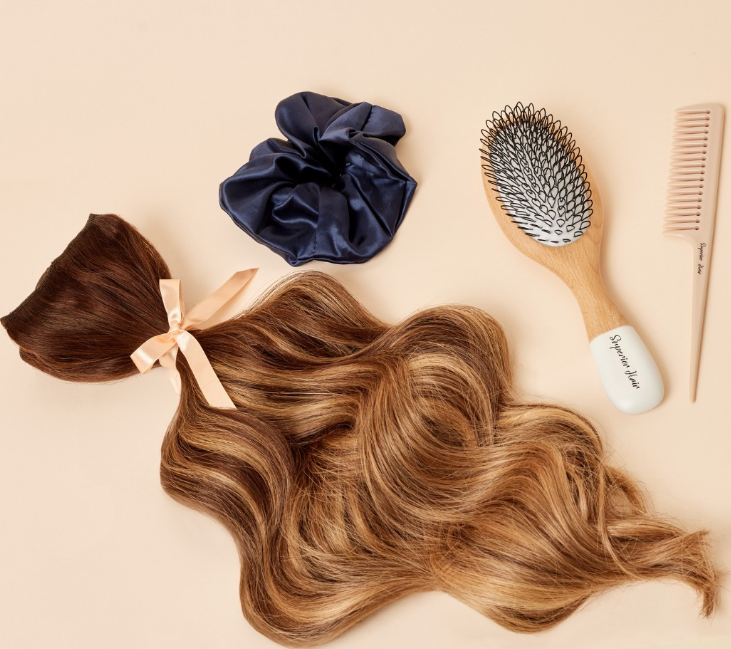
The Invisi butterfly weft keeps that exact system and changes the one part that touches your scalp. Rather than the Genius weft base used on the original, it is built on our Invisi base, which was re-engineered from customer feedback to be smoother, stronger, and more discreet. Each weft is 36 cm wide (roughly 14 inches) and comes in 20 inch (50g) and 24 inch (60g) lengths, in more than 40 shades. Like every Superior Hair line, it is 100% Remy human hair with the cuticle kept intact and running in one direction.
Comparing methods?
Butterfly wefts sit alongside tape-ins, nano tips, and keratin bonds in our salon-installed range. Seeing them side by side makes it easier to pick the one that fits your hair.
Browse all semi-permanent professional extensions →Why the Invisi base sits so flat
Flatness comes down to three things: how thick the base is, how the attachment point sits, and whether anything has to bulk up underneath.
A thinner, skin-like base
The Invisi base is the same material behind our Invisi Tape skin weft extensions, a line designed to disappear against the scalp at the part. Putting that base on a butterfly weft means the edge closest to your head is thinner and more flexible than a standard weft track. It bends with the curve of the head instead of sitting on top of it.
Beads hidden underneath, not stacked on top
On a beaded row weft, the beads and the weft share the same line, which adds height. With a butterfly weft, the beads sit on the underside once the weft is flipped. The weft then lies over them like a flap, so the surface your fingers touch is smooth.
No thread, glue, or braid
A sewn-in weft needs a braid or bead track to sew onto, and that foundation has its own thickness. Tape-ins need adhesive. The Invisi butterfly weft needs neither, so there is no extra layer between the base and your scalp. Combine all three and you get the lowest profile in our weft range, which is why we call it the flattest weft we make.
Invisi butterfly vs Genius butterfly and other wefts

If you already know the Genius Butterfly Weft, the Invisi version will feel familiar. Same width, same lengths and weights, same two-holes-per-bead install, same 15-minute application time. The difference is the base. The Genius butterfly uses a silk-style Genius base; the Invisi uses the smoother Invisi base. Here is how both compare with our other wefts.
| Weft | Base | How it attaches | Best for |
|---|---|---|---|
| Invisi Butterfly Weft | Thin, smooth Invisi base, 36 cm wide | Microbeads through pre-punched holes, flipped to hide beads. Not sewn. | Fine hair, clients who want the flattest possible finish |
| Genius Butterfly Weft | Silk-style Genius base, 36 cm wide | Same butterfly-hole bead install. Not sewn. | Fast, glue-free volume on most hair types |
| Genius Weft | Super-thin track, 80 cm wide | Beaded or sewn | Stylists who want to customize row length |
| Machine Weft | Thicker, sturdy track | Beaded or sewn, can be cut to size | Thick hair, maximum volume and length |
So is the Invisi version simply better? Not for everyone. On thick, coarse hair, the extra flatness is harder to notice because your own hair already covers the row well. Stylists who prefer sewing may still reach for a Genius or machine weft. Where the Invisi version earns its place is fine and medium hair, where every millimeter of lift shows. Our earlier guide to Genius butterfly weft extensions and volume without the bulk covers the original method in more depth.
Not sure of your shade?
Invisi and Genius butterfly wefts share one shade system. Check the full lineup of solids, highlights, balayage, and rooted colors before you or your stylist orders.
View the butterfly weft color guideWho they suit, and who should choose something else

Invisi butterfly wefts are a strong fit if you:
- Have fine or fragile hair and want volume without a visible track. Because each bead grips hair through two holes, the weight spreads across the section instead of pulling on one point.
- Want to avoid adhesive, whether because tape has lifted on you before or you simply prefer no glue near the scalp.
- Wear your hair up or in high ponytails and worry about rows showing at the nape.
- Want a quick appointment. Around 15 minutes per row is realistic in trained hands.
It is worth thinking twice if you:
- Swim often. The care guidance for this line is to avoid swimming with the extensions in, so a clip-in might suit beach weeks better.
- Cannot commit to a move-up every 4 to 6 weeks. As your hair grows, beads move away from the scalp and need repositioning.
- Are dealing with sudden or patchy hair loss. Any beaded method needs healthy anchor hair. See a doctor first, and ask about toppers if you need coverage rather than length.
How a stylist installs them
This is a salon method. It uses tension, sectioning, and pliers close to the scalp, and getting any of those wrong can stress your natural hair. Here is what happens in the chair so you know what to expect.
- Sectioning. Your stylist parts a clean horizontal row and clips the rest away. You should arrive with clean, product-free hair.
- Beading. Using a hook or loop needle, they pull a small section of your hair through a pair of butterfly holes and into a silicone-lined microbead, then close the bead with pliers. Bead color is matched to your root color.
- Repeat along the row. Beads are placed evenly across the 36 cm weft so weight is shared.
- Flip. The weft is folded down over the beads, hiding them and leaving the smooth side facing out.
- Blend. The extensions are cut and layered into your own hair so the ends don't sit in a blunt line.
For stylists, the kit is a hook needle, loop needle, pliers, silicone-lined microbeads, and hair grips, with croc clips to manage sections. A weft tool kit covers the tools (beads are sold separately). If butterfly wefts are new to your menu, the self-paced online butterfly weft training course walks through sectioning, placement, beading, and blending, and finishes with a certification.
How many packs you need and choosing a shade
For a full head, most people use 2 to 4 packs. Finer hair and shorter target lengths sit at the lower end; thick hair or the 24 inch length for a dramatic finish sits at the upper end. For a little extra fullness or a partial install, 1 to 2 packs may be enough. Order one extra pack as a buffer; unopened packs can be returned within the store's return window.
When matching color, look at the mid-lengths of your hair, not the roots or the ends. Roots are often darker and ends are often lighter or sun-faded, so the mid-length is what the extensions will actually sit against. If you have grown-out color or a natural root, the rooted shades (such as Rooted Beach Blonde or Rooted Champagne Chestnut) blend the transition without a hard line. Dark brunettes can start with a solid such as #2 Dark Brown Invisi Butterfly Weft. Still unsure? Our free shade matching service will look at a photo and recommend a match before you buy.
Aftercare and how long they last
Each install lasts 4 to 6 weeks before a maintenance appointment, where your stylist opens the beads, moves the weft back up to the root, and re-secures it. With proper care, the hair itself can be reused for up to a year of wear.
Do:
- Wash with a sulfate-free shampoo and use alcohol-free styling products.
- Brush with an extensions-friendly brush, holding the hair near the row as you work down.
- Use heat protectant, and keep hot tools away from the roots and bead area.
- Loosely braid or tie your hair before bed so the lengths don't tangle.
Avoid:
- Brushing hair while it is wet, and rough towel drying.
- Washing daily. Dry shampoo between washes is kinder to the hair.
- Conditioner near the beads or roots, which can make beads slip.
- Coconut oil products (argan oil is fine), volumizing or color-care shampoos, and anything containing alcohol.
- Tight ponytails in the first week while your scalp adjusts.
- Bleaching, lightening, or recoloring the extensions yourself.
Why does Remy hair reward this care? Because the cuticle is intact and aligned, strands slide past each other instead of catching. Harsh products lift that cuticle and tangling starts. Our article on why cuticle-intact Remy hair lasts longer explains the difference, and the Superior Hair care guide has product-by-product advice.
Ready for the flattest finish we make?
Choose from 40+ shades in 20 and 24 inch lengths, all 100% Remy human hair on our smoothest Invisi base.
Shop Invisi Butterfly Weft Extensions →FAQ
What is the difference between invisi butterfly weft extensions and the original butterfly weft?
Both use the same butterfly-hole microbead install, the same 36 cm width, and the same 20 inch and 24 inch lengths. The difference is the base. The original Genius Butterfly Weft uses a silk-style Genius base, while the Invisi Butterfly Weft is built on Superior Hair's thinner Invisi base, which sits smoother and more discreetly against the scalp.
Are invisi butterfly weft extensions good for fine hair?
Yes. Invisi butterfly wefts are one of the better semi-permanent options for fine hair because the base lies flat and each microbead grips hair through two holes, spreading weight across the section. There is no glue or sewing, which reduces stress on the natural strands. A trained stylist should still assess your hair density before installing.
How long do invisi butterfly weft extensions last?
Each install lasts 4 to 6 weeks before your stylist moves the wefts back up to the root. The hair itself can be reused for up to a year of wear with proper care, including sulfate-free shampoo, alcohol-free products, heat protectant, and keeping conditioner away from the beads.
How many packs of invisi butterfly weft do I need?
Most full-head installs use 2 to 4 packs, depending on your natural thickness and how much volume you want. Each pack is 50g at 20 inches or 60g at 24 inches. For added fullness or a partial install, 1 to 2 packs may be enough. Ordering one extra unopened pack is a sensible safety margin.
Can I install invisi butterfly weft extensions myself?
They are designed for professional installation. The method involves sectioning, threading hair through microbeads with a needle, and closing beads with pliers close to the scalp, where incorrect tension can stress your natural hair. Book a trained extensions stylist. Stylists can learn the method through Superior Hair's online butterfly weft training course.
Do invisi butterfly weft extensions use glue or tape?
No. Invisi butterfly weft extensions attach with silicone-lined microbeads only. There is no glue, no tape, and no sewing. Although the base shares its material with Superior Hair's Invisi Tape line, the butterfly version has no adhesive. The weft is beaded through pre-punched holes and flipped to hide the beads.