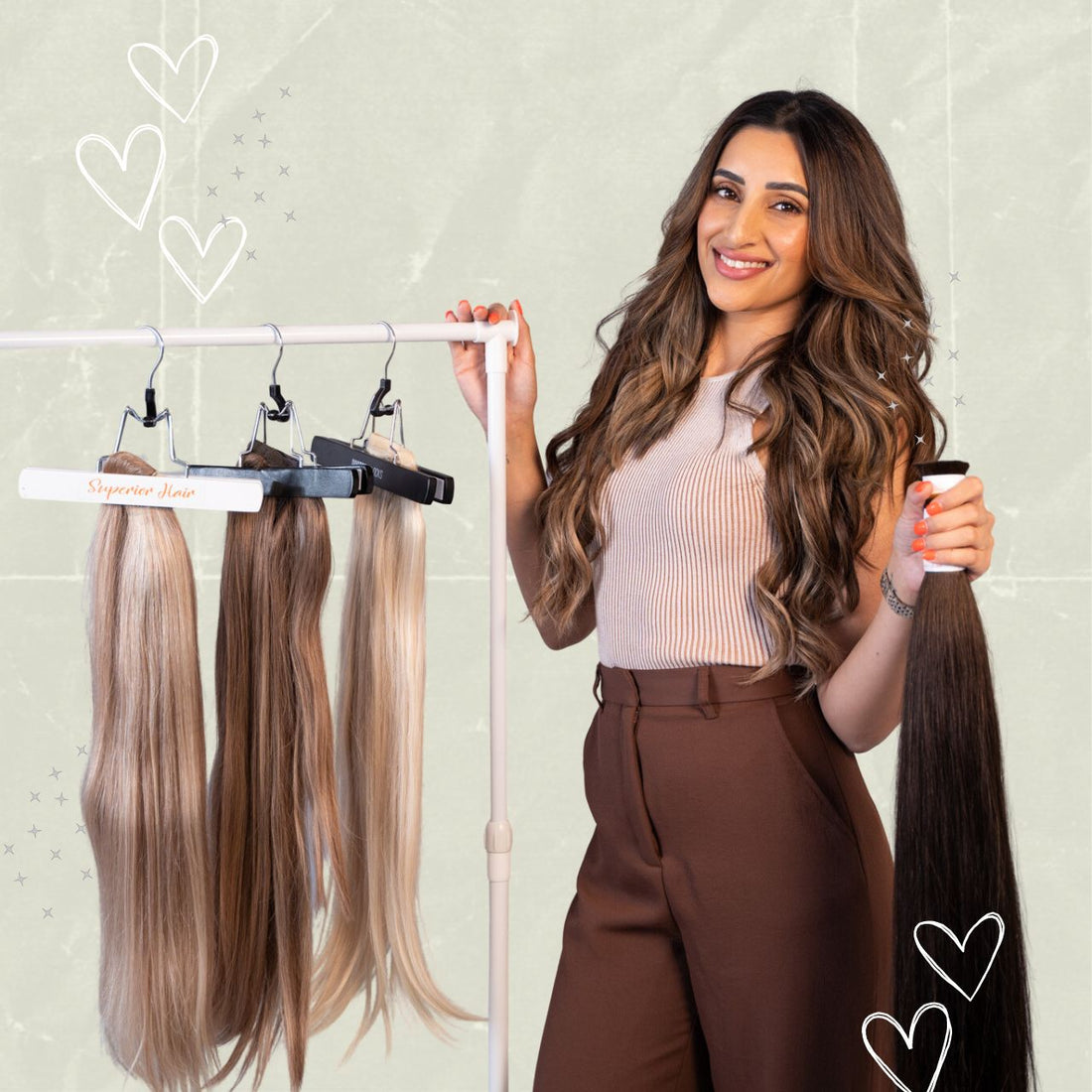

Invisi Tape-In Extensions Explained: How Skin Weft Extensions Really Work
Quick answer
Invisi tape in extensions are semi-permanent skin wefts built on an ultra-thin injection tape base that mimics hair growing from the scalp. A stylist sandwiches a section of your hair between two wefts. Each pack holds 10 wefts, install takes around 45 minutes, and a set wears 6 to 10 weeks before repositioning.
Most people asking about invisi tape in extensions have already tried something else. Clip-ins that got tiresome. Traditional tape-ins with a bond you could feel through a ponytail. The question underneath is the same one: can I add length without anyone being able to tell, and without wrecking my own hair? This guide covers what the skin weft is, what happens in the chair, what upkeep really costs you, and where it is not the right call.
In this guide
- What invisi tape in extensions actually are
- How they go in, and why it is a salon job
- Who skin wefts suit, and who they don't
- Invisi tape-ins vs seamless tape-ins vs butterfly wefts
- How many packs you need and how color matching works
- How long a set lasts and what upkeep really involves
- Aftercare that protects the bond and your own hair
- Invisi tape-in FAQ
New to semi-permanent hair?
Skin wefts are one of several professional methods, and the right one depends on your hair density, your budget for upkeep, and how often you want to sit in a salon chair.
Browse every professional semi-permanent method →What invisi tape in extensions actually are
An invisi tape weft is a strip of 100% Remy human hair attached to an injection-molded skin base. The word "skin" is doing real work there. Instead of hair being sewn or clamped onto a visible track, each strand is injected through a transparent polyurethane band so it appears to emerge from a scalp-colored surface. Hold one up to the light and you can see through it.
The practical numbers: each weft is about 2.5g and cut 4cm wide, and a pack contains 10 wefts, which is five sandwiches once installed. The base is thin enough that a finished row sits almost flush against the head. That is why people move to this method after a chunky bond they could feel every time they tied their hair back.
Remy matters as much as the base does. In Remy hair the cuticles are intact and all running the same direction, root to tip, the way hair grows. That alignment is what stops extensions matting at the nape after a few weeks. Superior Hair has supplied Remy human hair since 2003, and the invisi tape line uses top-grade virgin hair, not hair stripped and re-coated to fake a smooth finish. The Superior Hair care guide is a useful companion read once you have a set.
How they go in, and why it is a salon job
The application is a sandwich. Your stylist sections a fine horizontal panel of your own hair, places one weft underneath it, and lays a second weft on top so the two adhesive faces meet with your hair pressed between them. Repeat, row by row, working up the head. A full head typically takes about 45 minutes in the chair.
This is not a method you fit yourself. Three things go wrong when skin wefts are applied by someone untrained. Sections get taken too thick, so a small amount of natural hair carries the full weight of the sandwich. Wefts sit too close to the root, so every head movement pulls at the follicle. And placement creeps toward the hairline, where the row shows the moment your hair moves. Tension at the root is the real damage risk with tape methods, not the tape itself.
Your hair also needs to be freshly washed and completely free of product and conditioner residue before the appointment. Silicone and oil on the hair shaft is the single most common reason a bond slips in week one. If you don't already have a stylist who fits this method, find a salon near you that stocks Superior Hair rather than taking a chance on a general salon that fits extensions occasionally.
Who skin wefts suit, and who they don't

Invisi tape-ins are suitable across a wide density range, from fine to thick hair, and they are one of the least damaging semi-permanent options available precisely because the load spreads across a 4cm band instead of concentrating on a single bonded point. That flat, wide distribution is kinder to fine hair than a row of individual keratin bonds carrying the same total weight.
They suit you if you want length you can wear continuously and you are happy booking a salon appointment every couple of months. They are the wrong call in three honest cases. If you swim regularly, tape bonds and chlorinated or salt water are a bad combination. If you want extensions for one wedding or one holiday, seamless tape-ins or a temporary option makes more financial sense. And if your concern is scalp coverage through the part line rather than length, a topper or scalp fill-in solves that in a way a row of wefts cannot.
Invisi tape-ins vs seamless tape-ins vs butterfly wefts

These three methods get compared constantly because they all sit flat and all avoid heat and glue. The differences are in the base and in how they attach.
| Method | Base and attachment | Wear per application | Best for |
|---|---|---|---|
| Invisi tape skin weft | Injection skin base, taped sandwich, around 45 minutes | 6 to 10 weeks, reusable up to three times | The most scalp-like, undetectable finish |
| Ultra seamless tape-in | Small tape bond with no sew lines, taped sandwich | 8 to 10 weeks, reusable up to four times | Fine hair and mixing lengths from 14 to 26 inches |
| Invisi butterfly weft | Invisi tape base with butterfly holes, silicone-lined microbeads, around 15 minutes | Move-up interval set by your stylist | No tape or glue at all, weight spread across beads |
These methods are also compatible. Both tape systems use the same sandwich principle, so a stylist can pair a skin weft underneath with a seamless weft on top in the same section to fine-tune weight across the head. If beads appeal more than adhesive, the invisi butterfly weft range uses the same invisi base but anchors with microbeads, and installs in roughly a third of the time.
Not sure which shade to order?
Skin wefts sit close enough to the scalp that a shade half a level off will read as a stripe. The injection tape color guide shows every available shade in the line so you can compare against your mid-lengths before you commit.
See the injection tape color guideHow many packs you need and how color matching works
For a standard full head, plan on 4 to 6 packs, which is 40 to 60 individual wefts. Where you land depends on your density and how much length you are adding: a chin-length bob taken to mid-back needs more coverage than four inches added to shoulder-length hair. A partial install for volume alone uses considerably less.
Because the wefts come in 10-piece packs, mixing shades is straightforward and it is what makes a set look real. Very few people are one flat color. Blending two adjacent shades, or running a slightly deeper shade through the rows nearest the crown to shadow the root, is what stops extensions reading as a block of color hanging under your own hair.
Match to your mid-lengths and ends, not your roots, and judge in daylight rather than salon or bathroom lighting, which pushes shades warm or ashy. If you are ordering without a swatch in hand, the free color match service lets you send photos and have the shade selected for you. Photograph the mid-lengths to ends clearly, in daylight, with no filters, from the front, back, and sides.
How long a set lasts and what upkeep really involves
Two different lifespans get confused in every extensions conversation.
The first is wear time between appointments: 6 to 10 weeks per application. Your hair grows, the row travels down the shaft, and once it has moved too far the bond is both visible and mechanically riskier, because the extension hangs off a longer lever of natural hair. At that point your stylist removes the wefts, re-tapes them, and reinstalls at the root. That is the move-up appointment.
The second is the life of the hair itself. Invisi tape wefts can be reused up to three times, which means one set of hair can carry you close to a year with careful handling. Budget accordingly: your ongoing cost is mostly the re-tape and reinstall labor, with a fresh set of hair needed roughly annually rather than every appointment. That is a meaningfully different equation from methods where the hair is discarded at removal.
What shortens a set is almost always mechanical or chemical: brushing wet, oil-based products softening the adhesive, or bleaching. Extensions have already been through a coloring process, so lightening them is at your own risk and usually ends in a dry, brittle set.
Aftercare that protects the bond and your own hair
The first week sets the tone. Wait at least 24 hours after application before washing, and avoid tying your hair up while your roots adjust to the added weight. Skip color or chemical treatments for 24 hours before the appointment and 48 hours after.
After that, the routine is simple and mostly about what you keep away from the bonds:
- Sulfate-free shampoo and alcohol-free styling products, always.
- Conditioner through the mid-lengths and ends only, never at the roots or bonds.
- No coconut oil based products, which break down adhesive. Argan oil is fine.
- Wash every second or third day rather than daily, and use dry shampoo in between.
- Never brush hair while it is wet, and use an extensions-friendly brush the rest of the time.
- Heat protectant every time, and keep irons and dryers away from the root area and the bonds.
- Loosely braid or tie your hair before bed to stop overnight tangling at the nape.
- Take extensions out of the equation before swimming.
None of it is fussy once it becomes habit, and it is the difference between a set that reuses cleanly three times and one finished after a single wear. For a fuller routine, our guide on caring for tape-in extensions properly covers the day-to-day in more depth, and there is more background on the line itself in everything you need to know about invisi tape-ins.
Ready to build your set of invisi tape-ins?
100% Remy human hair on an ultra-thin skin base, 10 wefts per pack, in a shade range built for blending rather than guessing.
Shop invisi tape skin weft extensions →Invisi tape-in FAQ
Are invisi tape in extensions damaging to your hair?
They are one of the least damaging semi-permanent methods available, because the weight spreads across a 4cm weft rather than concentrating on a single bonded point. Damage risk comes from application error and aftercare, not the tape itself: sections taken too thick, placement too close to the root, brushing wet hair, or leaving a set in past the move-up window.
How long do invisi tape in extensions last?
Each application wears 6 to 10 weeks before the row grows out far enough to need repositioning. The hair itself is reusable up to three times, so one set can last close to a year when it is washed with sulfate-free products, kept away from oil-based residue at the bonds, and re-taped by a professional at each move-up appointment.
How many packs of invisi tape wefts do I need?
A standard full head takes 4 to 6 packs, or 40 to 60 wefts, since each pack holds 10 wefts at roughly 2.5g apiece. Denser natural hair and bigger length jumps push you toward six packs. If you only want volume through the mid-lengths rather than full coverage, fewer packs will do the job.
Can I install invisi tape skin wefts myself?
No. Invisi tape skin wefts must be fitted by a salon professional. The install takes around 45 minutes and depends on correct section thickness, correct distance from the root, and clean placement away from the hairline. Getting any of those wrong is what causes tension damage and slipping bonds, which is why the method is professional-only.
What is the difference between invisi tape-ins and regular tape-ins?
Invisi tape wefts are built on an injection skin base where hair is injected through a transparent band, so the bond mimics hair growing from the scalp. Regular and seamless tape-ins use a fabric-backed tape bond. Both install as a sandwich, both lie flat, and the two can be mixed in the same head by your stylist.
Will invisi tape-ins work on fine or thin hair?
Yes, the line is suitable for hair from thin to thick, and the wide, flat bond distributes weight better than individual bonded methods. Your stylist should reduce the number of rows and keep sections generous for finer hair. If your concern is visible scalp through the part rather than length, a topper or scalp fill-in is the better solution.