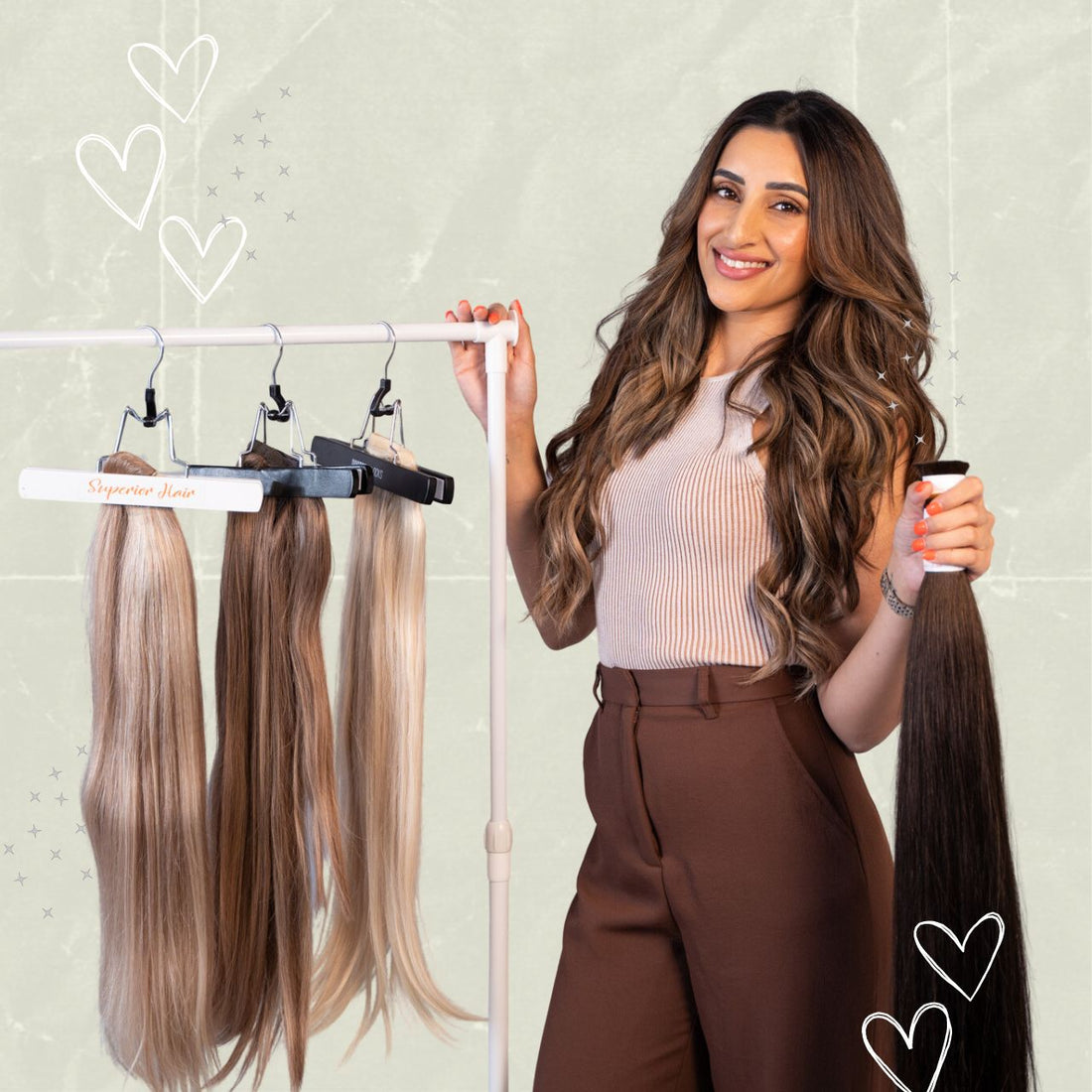

Seamless Tape-In Hair Extensions: The Complete Guide
Quick answer
Seamless tape in hair extensions are 4-cm wefts of Remy human hair on a thin adhesive bond, sandwiched around a section of your own hair by a stylist. They lie flat with no sew line, suit fine to thick hair, sit for 8 to 10 weeks between move-ups, and can be reused up to four times.
Tape-ins have a reputation problem left over from the thick, rubbery bonds of a decade ago. The seamless version fixed most of what people disliked: the bond is smaller, lighter, and flat enough that you can part your hair over it. This guide covers what you are actually buying, how many packs you need, what happens in the chair, and what it takes to keep a set looking like your own hair rather than something stuck to it.
In this guide
New to semi-permanent hair?
Tape-ins are one of seven professional methods Superior Hair makes, and they are not automatically the right one. Seeing the full range side by side is the fastest way to work out where your hair fits.
Browse all professional semi-permanent methods →What seamless tape-in hair extensions are
A seamless tape-in is a flat weft of hair about 4 cm wide, attached to a strip of medical-grade adhesive rather than stitched to a track. There is no sew line, which is the detail the name refers to. Traditional wefts have a visible seam where the hair is machine-sewn; a seamless bond does not, so it disguises easily under a natural part.
They are fitted in pairs. Your stylist takes a fine section of your own hair, places one weft underneath it and one on top, then presses the two together so your hair is sandwiched between them. Each pack contains 10 wefts, which is 5 of those sandwiches.
The hair itself matters more than the bond. Superior Hair uses 100% Remy human hair with the cuticles intact and running in the same direction, which is why a well-kept set stays smooth instead of matting at the nape after a few washes. Hair that has had its cuticle stripped feels fine in the first month and then starts to tangle against itself. If you want the longer version of why cuticle alignment changes how a set ages, there is a breakdown of double drawn Remy hair on the Superior Hair blog.
How seamless tape-ins compare to other methods

Most people arrive deciding between three or four methods rather than shopping for tape-ins specifically. Here is how the closest options line up on the numbers that actually affect your decision.
| Method | How it attaches | Wear per fitting | Reuses | Best for |
|---|---|---|---|---|
| Seamless tape-in | Adhesive sandwich, 4-cm wefts | 8 to 10 weeks | Up to 4 | Fine to thick hair wanting flat, low-profile length |
| Invisi-tape skin weft | Ultra-thin bond mimicking the scalp | 6 to 10 weeks | Up to 3 | Very fine hair, or anyone who wears tight parts and updos |
| Nano tip | 1 g strands clamped into silicone-lined beads | 6 to 10 weeks | Up to 3 | Hairlines, face-framing, no heat or adhesive at all |
| Seamless clip-in | Clips on silicone wefts, worn at home | Hours, in and out daily | Unlimited | Occasional length with no salon commitment |
The honest read: tape-ins win on wear time and reuse, and they are quick to move up. If your hair is very fine or you wear a hard part daily, the invisi-tape skin weft range hides better. If you want extensions right up at the hairline, or you dislike the idea of adhesive entirely, nano tips are the better fit because each strand rotates 360 degrees. And if you are not ready to book a salon appointment every couple of months, seamless clip-ins give you most of the look with none of the maintenance schedule.
Who seamless tape-ins suit, and who should choose something else

Seamless bonds are smaller and lighter than traditional tape bonds, which is what makes them workable on thinner hair. They suit hair from fine through to thick, and they are particularly good if you want length that behaves like your own hair when it is down: no ridge, no lifting, no shadow under a blow-dry.
They are less suited to a few situations. Very short hair does not give enough coverage over the top weft, so bonds show. Hair that is actively shedding or breaking should be assessed by a stylist before anything is bonded to it, because tape adds weight to the root. And if you swim regularly, tape-ins are the wrong method; chlorine and salt water both degrade the adhesive, and Superior Hair advises against wearing extensions to swim.
Weight is worth thinking about too. If your natural hair is genuinely sparse rather than just fine, a full head of tape-ins may be more than your roots should carry. This is a conversation to have with a stylist before you buy, not after.
How many packs, what length, and what weight
This is where most first orders go wrong, usually by under-buying. Superior Hair's seamless tape-ins come in four lengths, and the weight climbs with the length:
- 14 inch, 22 g per pack, 2.2 g per weft
- 18 inch, 28 g per pack, 2.8 g per weft
- 22 inch, 30 g per pack, 3.0 g per weft
- 26 inch, 35 g per pack, 3.5 g per weft
Every pack holds 10 wefts, or 5 sandwiches. For added volume without much extra length, 1 to 2 packs is usually enough. For a standard full head, plan on 4 to 6 packs. Thick or very long natural hair sits at the top of that range, and sometimes above it, because the extensions have to match the density of what is already there or the ends look thin by comparison.
On length: pick based on where your hair currently ends, not on the number you like the sound of. A 26 inch set on shoulder-length hair is a big jump and needs enough packs to avoid a see-through finish. Going up one or two lengths at a time reads more naturally and is easier to blend when your stylist cuts the set in.
Getting the color right
Color is the single biggest reason a set looks obvious. The seamless tape-in range currently runs to more than 50 shades across blondes, browns, blacks, auburns, grays, balayage and ombre blends, highlighted multi-tones, and rooted shades, which exist specifically so the color at the bond is darker than the mid-lengths and grows out without a line.
Match to your mid-lengths and ends rather than your roots, since that is where the extension hair actually sits. If your own color is dimensional, a single flat shade will fight it; a highlighted or balayage blend usually reads better. The seamless tape-in color guide shows every shade in the line so you can compare tones properly instead of judging from a product thumbnail.
One thing to plan around: color your own hair before your fitting, not after. Superior Hair advises against dyeing or treating your hair in the 24 hours before application and the 48 hours after, and the extensions themselves should not be bleached or lightened.
Not sure of your shade?
Send a few photos of your hair in natural light, front, back, and sides, and the Superior Hair team will match your shade for you before you commit to a full set.
Get a free color matchWhat happens at your fitting
Seamless tape-ins are a professional install. They are among the easier methods in the semi-permanent range, but placement, tension, and section size all affect whether your natural hair comes through the next few months intact, so this is salon work rather than a home project. A full head typically takes around an hour.
Arrive with freshly washed hair and no product in it. Residue, oil, and silicone all stop the adhesive gripping, and a bond that never grips properly will slide within a fortnight. Your stylist will section, place the wefts in rows, then cut and blend the set into your own layers, which is the step that does most of the work in making it look like hair rather than length that has been added.
After that, wait at least 24 hours before your first wash, and avoid tying your hair up during the first week while the bonds settle. If you do not already have a stylist who fits this method, you can find a Superior Hair salon near you.
Move-ups, aftercare, and how long a set lasts

A set of seamless tape-ins sits for 8 to 10 weeks before it needs repositioning. Your hair grows, the bonds travel down with it, and at some point they are far enough from the scalp to be visible and to tug. At the move-up appointment your stylist removes the wefts, re-tapes them, and puts them back at the root.
The same hair can go through that cycle up to four times with proper care, which is what makes the method economical over a year compared with buying fresh hair every couple of months. Care is the variable there, not luck. The habits that decide it:
- Sulfate-free shampoo and alcohol-free styling products, always.
- Conditioner through the mid-lengths and ends only, never at the roots or bonds.
- No coconut oil based products, which break down the adhesive. Argan oil is fine.
- Never brush wet hair, and use an extensions-friendly brush when it is dry.
- Heat protectant every time, and keep hot tools away from the bonds themselves.
- Loosely braid or tie your hair back at night to stop it twisting around the wefts.
- Wash less often than you think. Dry shampoo between washes is better than daily shampooing.
Tangling at the nape is the most common complaint, and it is nearly always a care issue rather than a hair-quality one. There is a fuller routine, including what to do when a weft starts to slip, in the Superior Hair guide to caring for tape-in extensions.
Ready to choose your seamless tape-ins?
More than 50 shades in 14, 18, 22 and 26 inch, all 100% Remy human hair, made by a factory that has been doing this since 2003.
Shop seamless tape-in extensions →Frequently asked questions
Are seamless tape-in hair extensions damaging?
Seamless tape-ins are the least damaging of the semi-permanent methods because the bond is small, light, and spreads weight across a 4-cm weft rather than a single point. Damage comes from poor placement, too much weight for the hair, or skipping move-ups, not from the method itself. A professional install and an 8 to 10 week schedule keep the risk low.
How long do seamless tape-in hair extensions last?
Each fitting lasts 8 to 10 weeks before the wefts need repositioning at the root. The hair itself can be re-taped and reused up to four times with proper care, so one set of Remy human hair generally covers close to a year of wear before it is replaced.
Can I install seamless tape-in extensions myself?
No. All semi-permanent extensions, tape-ins included, should be applied by a certified stylist. Section size, tension, and how far the bonds sit from the scalp all affect whether your natural hair stays healthy. If you want extensions you can put in yourself, seamless clip-ins are the at-home option.
How many packs of seamless tape-in extensions do I need?
For extra volume, 1 to 2 packs. For a standard full head, 4 to 6 packs. Each pack contains 10 wefts, which makes 5 sandwiches. Thicker or longer natural hair sits at the upper end of that range, because the extensions need to match your existing density or the ends will look sparse.
Do seamless tape-ins work on fine or thinning hair?
They work well on fine hair, since the seamless bond is much smaller and lighter than a traditional tape bond. Genuinely thinning or shedding hair is a different question, and should be looked at by a stylist or a doctor before anything is bonded to it. Invisi-tape skin wefts or a topper may suit better.
Can I swim or use heat tools with seamless tape-ins?
Heat tools are fine with a heat protectant, as long as you keep them away from the bonds and the root area. Swimming is not recommended: chlorine and salt water both degrade the adhesive and dry out the hair, which shortens how many times a set can be reused.